Mayo Clinic lost a law suit against the government in which Mayo tried to argue that housestaff, or physicians completing residency training, are students under the law rather than employees, or workers.
The case wended its way through the legal system, all the way up to the Supreme Court, which made a 8-0 ruling on January 11th, against Mayo Clinic, firmly establishing housestaff as employees rather than students. An interesting editorial on the events leading to the decision is available at the New England Journal of Medicine.
Showing posts with label news. Show all posts
Showing posts with label news. Show all posts
Friday, January 14, 2011


Wednesday, January 12, 2011
Suleymaniye Masjid restoration completed
 |
| Image via Sunday's Zaman newspaper |
Awe-inspiring from its opening, the Suleymaniye Masjid was a center of learning, service, as well as worship, and continues to play an active role in the lives of Turks today.
Many new discoveries were made during the restoration process, both artistic and scientific, such as new panels of calligraphy and an understanding of how the masjid achieved its amazing acoustics.
If you can't quite make it to Istanbul, there is a beautiful, online virtual tour of the grounds via the Aramco World website that dates back to 2006 (the latest restoration project started in 2007).
Full story via the Sunday's Zaman website.
Sunday, January 09, 2011
Multi-tasking
I'm terrible at multi-tasking: I like to, um, "uni-task?" Turns out, it's probably the right thing to do according to Harvard Business Review blogger Peter Bregman, in his article, "How (and Why) to Stop Multi-Tasking." My favorite line from his article:
We don't actually multitask. We switch-task, rapidly shifting from one thing to another, interrupting ourselves unproductively, and losing time in the process.
We don't actually multitask. We switch-task, rapidly shifting from one thing to another, interrupting ourselves unproductively, and losing time in the process.
Sunday, December 26, 2010
Leslie Hazelton: an agnostic Jew's reading of the Qur'an
Leslie Hazelton is a prolific writer, formerly a Middle East reporter, who has taken an interest in religious writing and describes herself as an "agnostic Jew." She is writing a book about the Prophet Muhammad, peace be upon him, and gives an interesting talk at TEDxRainier, about her experience with the Qur'an.
It is an intriguing 9 minutes
It is an intriguing 9 minutes
Monday, October 18, 2010
How to end suicide bombing
Robert Pape is a Professor in Political Science at the University of Chicago and a national expert on suicide terrorism. He has written several books and heads the world's largest academic research project on the subject.
 |
| Image via University of Chicago |
He has co-authored an important new book, "Cutting the Fuse: The Explosion of Global Suicide Terrorism and How to Stop It" in which he argues that suicide terrorism is essentially driven by political considerations rather than religious ones.
It echoes my belief that extremists distort Islamic tenets to achieve political aims among adherents who are largely ignorant of Islam's rich intellectual and spiritual tradition.
Indeed, traditional Islam has never accepted suicide under any circumstances nor has it ever accepted an "anything goes" approach to achieving political aims. The Islamic tradition is to first make and spread peace.
If nothing else, Pape's book argues for a more nuanced approach to dealing with the threat of extremism, one that avoids foreign occupation but still safeguards American interests both domestically and abroad.
Below is a copy of the press release from the University of Chicago:
How to End Suicide Bombings: New book argues the problem is not Islam, but lengthy military occupations.
October 4, 2010
The University of Chicago Project on Security & Terrorism and the New America Foundation will hold a major national policy forum in the U.S. Congress titled “Cutting the Fuse, Moving Beyond the War” on Tuesday, Oct. 12. The conference will be streamed live athttp://www.thewashingtonnote.com. For more information and a list of speakers, visithttp://cpost.uchicago.edu.
To put an end to suicide bombings, the United States needs a new strategy that would reposition troops and work with local allies to boost their fighting capacity, contends Robert Pape, a political scientist at the University of Chicago and one of the nation’s leading experts on suicide terrorism.
Despite a popular belief that suicide terrorism is the result of religious fanaticism, such bombings are really a calculated response to occupations by outsiders, according to research in a new book, Cutting the Fuse: The Explosion of Global Suicide Terrorism and How to Stop It. The book examines exhaustive data on suicide attacks since 1980 in the Middle East, Chechnya, Sri Lanka and around the world.
The data show that the best way to reduce suicide bombings in Afghanistan or Iraq is not to condemn Islamic extremism, but to end foreign occupations as quickly as possible, Pape claims.
Pape’s co–author is James Feldman, a former professor of decision analysis and economics at the Air Force Institute of Technology and the School of Advanced Airpower Studies. The book is published by the University of Chicago Press.
Their work shows that the suicide terrorism threat to America is growing, despite military efforts in Iraq and Afghanistan as well as Pakistan’s attempts to fight its own militants.
“Each month there are more suicide terrorists trying to kill Americans and their military allies in Afghanistan, Iraq and other Muslim countries than in all the years before 2001 combined,” Pape said. In addition to nations where the United States is involved in military conflicts, the United States also has stationed troops on the Arabian Peninsula, a situation that al Qaeda claims is the reason for its hostility to the U.S.
The central problem is that leaders in the United States have constructed a narrative that identified the threat as coming from Islamic extremists who hate the United States. That explanation led to the invasions, occupations and eventual efforts to establish democratic regimes, something that requires a heavy military presence, the authors explained.
“But we now have strong evidence that the narrative — that suicide terrorism is prompted by Islamic fundamentalism — is not true,” Pape said. Despite some military success, suicide terrorism has continued, Pape said.
The book’s extensive research points out that after the United States occupied Afghanistan and Iraq, suicide attacks worldwide rose dramatically — from 300 between 1980 and 2003 to 1,800 from 2004 to 2009. More than 90 percent of the attacks were anti–American. Indirect occupations, in which the United States helps lead an occupation without committing troops, such as in Pakistan, have the same impact as direct occupations and explain the rise of suicide terrorism there, Pape said. The research also showed that civilian casualties during occupations increase suicide terrorism by giving terrorist leaders rallying points to turn local residents against the invading force.
Pape oversees the Chicago Project on Security and Terrorism, the world’s largest academic research project on suicide terrorism, and Feldman is the project’s principal advisor. The CPOST team recently completed a study of more than 2,000 suicide attacks. The team also studied tapes left by suicide bombers and collected other key information, such as their religious backgrounds, methods and number of casualties resulting from the attacks.
The research found that in each of the countries where suicide terrorism flourished, it was used to combat an occupying force. While occupation may sometimes be necessary to achieve immediate foreign policy goals, it does so at the risk of stimulating a suicide terrorist campaign against the occupier’s homeland. This is the dilemma an occupier faces, Feldman noted, since when the threat of occupation was removed, suicide terrorism largely stopped. After Israel withdrew from southern Lebanon in 2000, for instance, Lebanese suicide terrorist attacks against Israel ended, Pape pointed out. Since Israel withdrew militarily from Gaza and portions of the West Bank, suicide attacks have been down 90 percent.
In order to end suicide terrorism, or to “cut the fuse,” the United States needs to “reduce the reliance on foreign occupation as a principal strategy for ensuring national interests,” they concluded.
“I’m not saying that we should cut and run, but rather that we have to use our military power differently,” Pape said. Offshore and in–country balancing would contain the threat to American rather than fuel it, he said.
Offshore balancing would involve stationing American forces on ships in the Persian Gulf and and islands in the Indian Ocean, and establishing military bases with non–Western forces on the Arabian Peninsula to support rapid deployment of ground forces, if needed in a future crisis.
In–country balancing involves working more closely with local forces, such was the case in Anbar Province in Iraq, where Americans empowered local Sunni leaders to be responsible for their own defense and accordingly curtailed insurgency.
“Intelligent debate and decision making require putting all the facts before us. For over a decade our enemies have been dying to win. By ending the perception that the United States and its allies are occupiers, we can cut the fuse to the suicide terrorism threat,” Pape said.
Saturday, October 16, 2010
A Conversation with President Obama
This is pretty cool, MTV, BET and CMT hosted a "Conversation with President Obama." Below is a link to the show, best parts come later in show:
Friday, October 15, 2010
Musharraf interviewed on This Week
Saw part of this interview of former Pakistani prime minister Pervez Musharraf, by This Week's Christiane Amanpour, in which Musharraf argues that Pakistan plays an important role in the fight against terrorism that is not fully acknowledged by the international community.
Over 2,000 Pakistani soldiers have died, in military actions against extremists, and many Pakistani civilians have lost their lives due to attacks by extremists as well as drone attacks that inadvertently hit civilian populations.
Musharraf has made quite a career for himself on the lecture circuit since leaving office, and has apparently evinced enough nostalgia for his leadership to form a new political party with the aim of returning to Pakistani politics. The problem with his tenure as prime minister has mainly to do with his lack of respect for civic institutions. The end of his term was marked by "emergency rule" and effective dissolution of the judicial branch of government in Pakistan.
Nevertheless, he does remind viewers in this segment that Pakistan continues to incur a high cost in the war against terrorism. No one is more interested in stability and an end to terrorism than Pakistanis.
Extremism in Islam is not native to Pakistan nor is it embraced by the majority of the population. Islam spread in Pakistan mainly by the efforts of Sufi scholars and saints, who still enjoy a special reverence in Pakistan today, both culturally (in terms of music, poetry) and religiously. Only by reconnecting to this spiritual tradition can we hope to battle extremist interpretations of Islam.
Over 2,000 Pakistani soldiers have died, in military actions against extremists, and many Pakistani civilians have lost their lives due to attacks by extremists as well as drone attacks that inadvertently hit civilian populations.
Musharraf has made quite a career for himself on the lecture circuit since leaving office, and has apparently evinced enough nostalgia for his leadership to form a new political party with the aim of returning to Pakistani politics. The problem with his tenure as prime minister has mainly to do with his lack of respect for civic institutions. The end of his term was marked by "emergency rule" and effective dissolution of the judicial branch of government in Pakistan.
Nevertheless, he does remind viewers in this segment that Pakistan continues to incur a high cost in the war against terrorism. No one is more interested in stability and an end to terrorism than Pakistanis.
Extremism in Islam is not native to Pakistan nor is it embraced by the majority of the population. Islam spread in Pakistan mainly by the efforts of Sufi scholars and saints, who still enjoy a special reverence in Pakistan today, both culturally (in terms of music, poetry) and religiously. Only by reconnecting to this spiritual tradition can we hope to battle extremist interpretations of Islam.
Sunday, October 10, 2010
In Health Bill, Obama Attacks Wealth Inequality
An interesting argument about the healthcare bill from NY Times columnist Leonhardt:
This disconnect is not healthy. America's middle class needs to be revived and it needs leaders who will represent and defend its interests. Instead, we've had the rise of the Tea Party whose reactionary zeal threatens not only our economic sensibilities but even more fundamental institutions such as religious freedom.
Astonishingly, the Democratic party seems unable to articulate a coherent response. Yet there could be no simpler strategy than to reaffirm our tradition of civil, religious and economic liberties that made this nation great.
In the interim, it is important for us all to do what we can to be more neighborly, to extend a helping hand to each other to show the kind of individual leadership that builds communities and societies.
The healthcare bill has important reform that went just short of what it could have been. Nevertheless, if Leonhardt is right, it will probably be the most important thing Obama has done in his presidency to date.
For all the political and economic uncertainties about health reform, at least one thing seems clear: The bill that President Obama signed on Tuesday is the federal government’s biggest attack on economic inequality since inequality began rising more than three decades ago.While I'm sure the assertion will be widely debated, I think it frames an important issue, the stark economic inequalities of our time. We see an economy in which there is 10% unemployment but the stock market is riding high with the Dow Jones at over 11,000.
This disconnect is not healthy. America's middle class needs to be revived and it needs leaders who will represent and defend its interests. Instead, we've had the rise of the Tea Party whose reactionary zeal threatens not only our economic sensibilities but even more fundamental institutions such as religious freedom.
Astonishingly, the Democratic party seems unable to articulate a coherent response. Yet there could be no simpler strategy than to reaffirm our tradition of civil, religious and economic liberties that made this nation great.
In the interim, it is important for us all to do what we can to be more neighborly, to extend a helping hand to each other to show the kind of individual leadership that builds communities and societies.
The healthcare bill has important reform that went just short of what it could have been. Nevertheless, if Leonhardt is right, it will probably be the most important thing Obama has done in his presidency to date.
Friday, October 08, 2010
Should we Fear Islam?
Keith Ellison, a Democratic congressman from Minnesota, has written an important opinion piece in the Washington Post's "On Faith" series, in which he offers an important analogy between the way the media is portraying Muslims in America and how that would look if the same portrayal was extended to the African American community.

Keith Ellison is not only an African American, he is also the first Muslim American to be elected to Congress. He has always taken a practical, inclusive approach to his politics, from which many others in Congress could learn.
Here is an excerpt from the article, which is worth a read:

Keith Ellison is not only an African American, he is also the first Muslim American to be elected to Congress. He has always taken a practical, inclusive approach to his politics, from which many others in Congress could learn.
Here is an excerpt from the article, which is worth a read:
We are having a national conversation about belonging. The threatened Qur'an burning in Florida and the controversy over the proposed Islamic Center in lower Manhattan are examples of this national conversation about whether America can stretch her arms wide enough to embrace Muslims too. Irresponsible and sensational depictions of Muslims in the popular media are not the cause of Islamophobia, but they certainly can make it worse. Recent news shows and media reports do nothing to shed light or understanding on this national conversation, which is too bad.
Wednesday, September 29, 2010
Research on coffee, brought to you by Dunkin Donuts
I love this, Dunkin Donuts and CareerBuilder funded a study to look at coffee habits in the workplace. Interestingly, health professions are at the top with nurses followed by physicians.
The hospital I go to next year actually has a 24-hour Dunkin Donuts in the basement, next to the cafeteria! I can just see a Dunkin Donuts board meeting: Agenda item #14: Hospitals, time to perk up those who are feeling down (or working there).

Also, not surprisingly, government workers at #12 on the list. They go on to say that coffee consumption correlates with productivity, so draw your own conclusions... :-)
The List:
1) Nurses
2) Physicians
3) Hotel workers
4) Designers/Architects
5) Financial/Insurance sales representatives
6) Food preparers
7) Engineers
8) Teachers
9) Marketing/Public Relations professionals
10) Scientists
11) Machine operators
12) Government workers
The hospital I go to next year actually has a 24-hour Dunkin Donuts in the basement, next to the cafeteria! I can just see a Dunkin Donuts board meeting: Agenda item #14: Hospitals, time to perk up those who are feeling down (or working there).

Also, not surprisingly, government workers at #12 on the list. They go on to say that coffee consumption correlates with productivity, so draw your own conclusions... :-)
The List:
1) Nurses
2) Physicians
3) Hotel workers
4) Designers/Architects
5) Financial/Insurance sales representatives
6) Food preparers
7) Engineers
8) Teachers
9) Marketing/Public Relations professionals
10) Scientists
11) Machine operators
12) Government workers
Wednesday, September 22, 2010
Pioglitazone (Actos) under FDA review
The FDA is now reviewing pioglitazone (Actos), a popular drug for the treatment of diabetes, for a possible link to bladder cancer. Pioglitazone has been gaining in popularity after a rival drug, rosiglitazone (Avandia), had been shown to increase cardiovascular risk. Pioglitazone sales top $3 billion annually, while rosiglitazone has fallen to less than $600 million annually due to the negative data on myocardial ischemia.
So far, the FDA is not recommending discontinuation of pioglitazone, as the association with bladder cancer comes from an interim analysis of a 10-year study being performed by the drug's manufacturer, Takeda.
The entire drug class of TZDs has come under increasing scrutiny over safety. I am beginning to think that the entire class of medication should be avoided and other means of controlling hyperglycemia in diabetics should be pursued.
Will be interesting to see what future data will reveal about pioglitazone.
So far, the FDA is not recommending discontinuation of pioglitazone, as the association with bladder cancer comes from an interim analysis of a 10-year study being performed by the drug's manufacturer, Takeda.
The entire drug class of TZDs has come under increasing scrutiny over safety. I am beginning to think that the entire class of medication should be avoided and other means of controlling hyperglycemia in diabetics should be pursued.
Will be interesting to see what future data will reveal about pioglitazone.
Friday, September 10, 2010
Muslim Americans Find their Voice Amid the Shouts
Story via NPR:
No one's really sure how many Americans are Muslim. The estimates range anywhere from 1 million to 7 million. But what's clear is that over the past few weeks and months, almost every poll that's been taken on Muslims has pointed to one conclusion: anti-Muslim sentiment is on the rise.
 |
| Image on NPR site via myfaithmyvoice.com |
Thursday, September 09, 2010
Muslim 'Day of Dignity' Observed in Baltimore
Nice story from the Baltimore Sun about Islamic Relief USA's Day of Dignity in Baltimore:
Under a printed head scarf and the warm sun, Candice Abdal-Rahim served hundreds of strangers food and drink that she could not sample until sundown.
She was observing the Muslim holy month of Ramadan by fasting and performing an act of charity at the annual Day of Dignity, a national effort organized by Islamic Relief and the church of Jesus Christ of Latter-day Saints.
Serving others "makes the day go quicker," said Abdal-Rahim, a city schools administrator.
Under a printed head scarf and the warm sun, Candice Abdal-Rahim served hundreds of strangers food and drink that she could not sample until sundown.
She was observing the Muslim holy month of Ramadan by fasting and performing an act of charity at the annual Day of Dignity, a national effort organized by Islamic Relief and the church of Jesus Christ of Latter-day Saints.
Serving others "makes the day go quicker," said Abdal-Rahim, a city schools administrator.
 |
| Image via Baltimore Sun |
American Muslims Ask, Will We Ever Belong?
Interesting piece from the NY Times:
For nine years after the attacks of Sept. 11, many American Muslims made concerted efforts to build relationships with non-Muslims, to make it clear they abhor terrorism, to educate people about Islam and to participate in interfaith service projects. They took satisfaction in the observations by many scholars that Muslims in America were more successful and assimilated than Muslims in Europe.
 |
| Via NY Times |
Wednesday, September 08, 2010
Indonesian Fashion scores Ramadan Hit
Via AFP:
JAKARTA — This Eid al-Fitr Muslim holiday, Malaysian Sharifa Ahmad is determined to make heads turn in her "Made in Indonesia" outfit -- a black flowing chiffon robe with embroidered neckline and matching headscarf hand stitched with Swarovski crystals.
"The dress is perfect for the holy day -- modest yet elegant. I'm definitely going to rock my little black Islamic dress," the 35-year-old civil servant told AFP.
 |
| Image via AFP |
Tuesday, September 07, 2010
Islam Spiritual Center takes root in downtown Santa Rosa
Nice story of a Muslim community in Santa Rosa, California, via the Press Democrat:
The call to prayer, “Allahu Akbar” — God is Greatest — is delivered by a gray-robed man in a black skullcap facing northeast into one cinder-block wall of the mosque, toward Mecca.
Outside, traffic moves along Mendocino Avenue a few blocks north of Old Courthouse Square.
 |
| Image via Press Democrat |
Reignited ire buffets Muslim students
News story from Boston Globe:
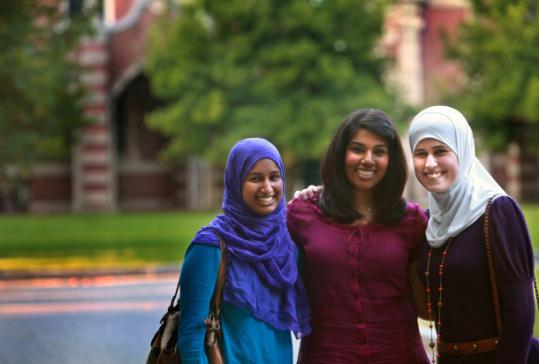
WELLESLEY — Laila Alawa fiddled with her cellphone, pretending she hadn’t heard what an apparently intoxicated man near her on the MBTA had said about “her people’’ wanting to build the “ground zero mosque.’’
Growing up in a large Muslim family in upstate New York and New Hampshire, Alawa had often drawn stares because of her headscarf, and sometimes endured harassment from neighborhood children. But this summer, as she shuttled between research jobs at Wellesley College and MIT, the looks and questions from strangers about where she was from seemed to come more often, and with a sharper edge.
WELLESLEY — Laila Alawa fiddled with her cellphone, pretending she hadn’t heard what an apparently intoxicated man near her on the MBTA had said about “her people’’ wanting to build the “ground zero mosque.’’
Growing up in a large Muslim family in upstate New York and New Hampshire, Alawa had often drawn stares because of her headscarf, and sometimes endured harassment from neighborhood children. But this summer, as she shuttled between research jobs at Wellesley College and MIT, the looks and questions from strangers about where she was from seemed to come more often, and with a sharper edge.
 |
| Image via Boston Globe |
Monday, September 06, 2010
Local Muslim families mix Ramadan's rituals with American culture
Story from Detroit Free Press:
In front of the fireplace in their Canton home, the Ahmed family has four shoeboxes, one for each of their kids, packed with small toys like "Star Wars" figures and Hot Wheels. They call them Ramadan boxes, an idea the parents came up with after noticing Christmas stockings.
 |
| Image: Detroit Free Press |
Wednesday, August 25, 2010
It's the American thing to do
 |
| Image via http://www.groundzerodialogue.org/ |
I do not have the eloquence of others, so I will simply direct you to Muslims and non-Muslims who have spoken up to defend one of our most cherished freedoms, the freedom of religion.
Here are a sampling:
1. Ground Zero Dialogue, site that explores the American Muslim perspective on the Ground Zero controversy. Several award-winning documentaries screening for free via the site.
2. Keith Olbermann: a scathing criticism of opponents to the community center.
3. Jon Stewart: several funny sketches that deliver important points about religious freedom and the inconsistencies of conservative news media like Fox.
4. Senator Richard Durbin (D-IL). It is nice to see the second-ranking Democrat take a strong position on this issue. President Obama's stance was so wishy washy (they have a right to build the center, but I don't necessarily agree with where they are building it) as to not even be a stance.
5. Qasim Basir, director of the movie, "MOOZ-lum" in his article, "I am a Muslimerican." I enjoy the line, "This is not a plea for sympathy; it is a call to character."
6. Fareed Zakaria, CNN journalist and Newsweek columnist, has come out strongly in favor of the community center. He even returned an award from the ADL, when he learned that they would not be supporting Park 51.
Sunday, August 08, 2010
More rain, flood worsens in Pakistan
 |
| Image via Reuters; Man saving two boys |
Please consider donating to help relief efforts in Pakistan. Previous post here details ways you can get involved. Perhaps the easiest, and most immediate, is to text SWAT to 50555 on your mobile phone. $10 donation to UNHCR, was announced earlier this week by Secretary of State Hillary Clinton. Islamic Relief USA is also doing major work there. Given the degree of damage, a UN official is predicting that rebuilding Pakistan will require billions of dollars.
 |
| Image via VOA News; Mother with children |
 |
| Image via Dawn Newspaper; flood survivor |
Subscribe to:
Posts (Atom)
